
Frequently Asked Questions
Q&A Table of Contents
- Q. Is it possible to repair or re-paper a wagasa?
- Q. What is the difference between a wagasa, a janome-gasa, and a bangasa?
- Q. How do I care for my wagasa?
- Q. How many years do they last?
- Q. How is a Gifu wagasa different from other wagasa?
- Q. About ordering (payment, shipping, returns/cancellations)
Q. Is it possible to repair or re-paper a wagasa?
A. If it's just filling a hole, we can patch it up, but it will be visible.
If you need to replace all the washi paper, it requires completely disassembling and rebuilding the umbrella from scratch, which will cost more than buying a new one.
Also, for wagasa that are over 20 years old, the bamboo frame is likely to have deteriorated, reducing its durability, and there is a risk of damage during restoration work.
Depending on the condition, our craftsmen may decline repair requests.


Q. What is the difference between a wagasa, a janome-gasa, and a bangasa?
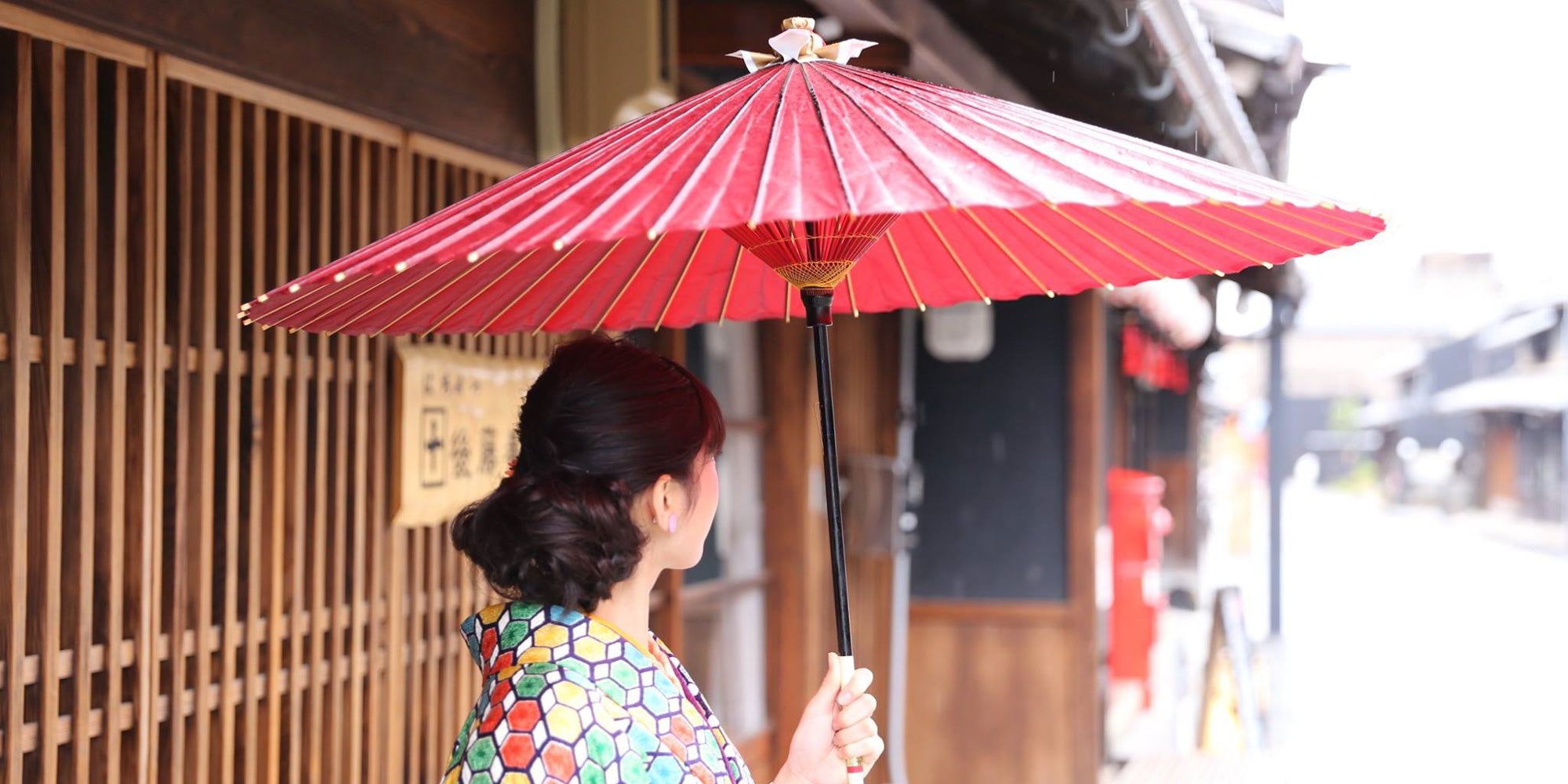
A. Both janome-gasa and bangasa are types of wagasa. They are umbrellas that can be used on rainy days.
Umbrellas used only on sunny days are referred to as "parasols" in our store.
There are also other types such as mai-gasa used in kabuki and traditional Japanese dance, nodate-gasa/oogasa used for tea ceremonies, sashikake-gasa used for Shinto rituals, and special umbrellas used for regional festivals. All of these are collectively called "wagasa".
●Janome-gasa
The pattern of rings replaced with white washi paper resembles a snake's eye (janome), hence the name "janome-gasa." In modern times, it generally refers to slightly slender umbrellas with decorative stitching.
- They often feature many decorative elements such as plain colors, patterns, and intricate designs, and can be chosen and used by both men and women according to their preference.
- Enjoy the "paran paran" sound of rain falling on the washi paper.
- They have a translucent quality, so you can enjoy two different color tones when viewed from the outside and inside.
- Since the washi paper is oiled to repel rain, prolonged use in hot conditions can cause the washi paper to deteriorate and become brittle. We recommend using them as rain umbrellas.
●Bangasa
Compared to janome-gasa, bangasa have thicker frames and handles, giving them a more substantial feel. They are simple, without ornamentation, and often larger in size.
- They typically use white washi paper, showcasing the natural texture of unpainted bamboo and the beauty of its lines.
- They are exquisite pieces that make you ponder functional beauty.
- Their large size allows a woman to snuggle up to a man holding one at weddings, for example.
- They are often used as sashikake-gasa (ceremonial parasols) with family crests or names of temples, shrines, or traditional restaurants.
●Parasol
Parasols allow you to enjoy the texture of washi paper even more, while gently blocking the sunlight.
- The light passing through the washi paper is soft, and when walking under trees, you can enjoy the changing patterns of sunlight filtering through the leaves.
- Those with detachable handles can be stored compactly, making them convenient for carrying.
- They are small, light, and easy to use without much maintenance, making them popular among women, but recently men have also started choosing them.
- Since they are not oiled to repel rain, they cannot be used on rainy days.

Q. How do I care for my wagasa?
A. When you return home, open and dry your wagasa either at your entryway or indoors. Close it once it's dry.
Repeatedly closing it while wet can lead to mold on the bamboo and washi paper, causing deterioration.
No other special care is generally needed.
Please also see:
Q. How many years do they last?
A. There's no general guideline for how many years they last, as it depends on the frequency and manner of use. However, some people use them for 5, even 10 years. If you use it carefully and extend its lifespan, it will prove to be a highly practical item.
Q. How is a Gifu wagasa different from other wagasa?
A. Gifu wagasa have long been praised for their slender beauty when closed; they are so elegant that they are said to be bamboo when closed, and a flower when open.
Q. About ordering (payment, shipping, returns/cancellations)
A.
Payment Methods
・Credit card payment
・Paypal
・Bank transfer
Juroku Bank, Gifu Chuo Branch, Ordinary Deposit, 1455917
Specified Non-Profit Organization ORGAN, President Yusuke Kamou (Tokuhi Organ)
Shipping Costs
We use Japan Post (Yu-Pack) for deliveries.
For Wagasa
Honshu, Shikoku: 1,200 yen
Kyushu: 1,300 yen
Hokkaido, Okinawa: 1,600 yen
For Wagasa bags only
Letter Pack Light: 420 yen nationwide
*If you purchase a wagasa bag along with a wagasa, it will be shipped together.
Shipping Information
We generally ship within 3 days, excluding holidays.
If you have a preferred delivery date and time, please select a date and time or specify it in the memo/remarks section.
Returns
Returns are generally not accepted unless the product has a defect.
Our products are handmade using natural materials (bamboo, wood, washi paper, etc.).
Due to the nature of these materials, there may be individual variations.
We appreciate your understanding and hope you enjoy the unique characteristics of the materials.